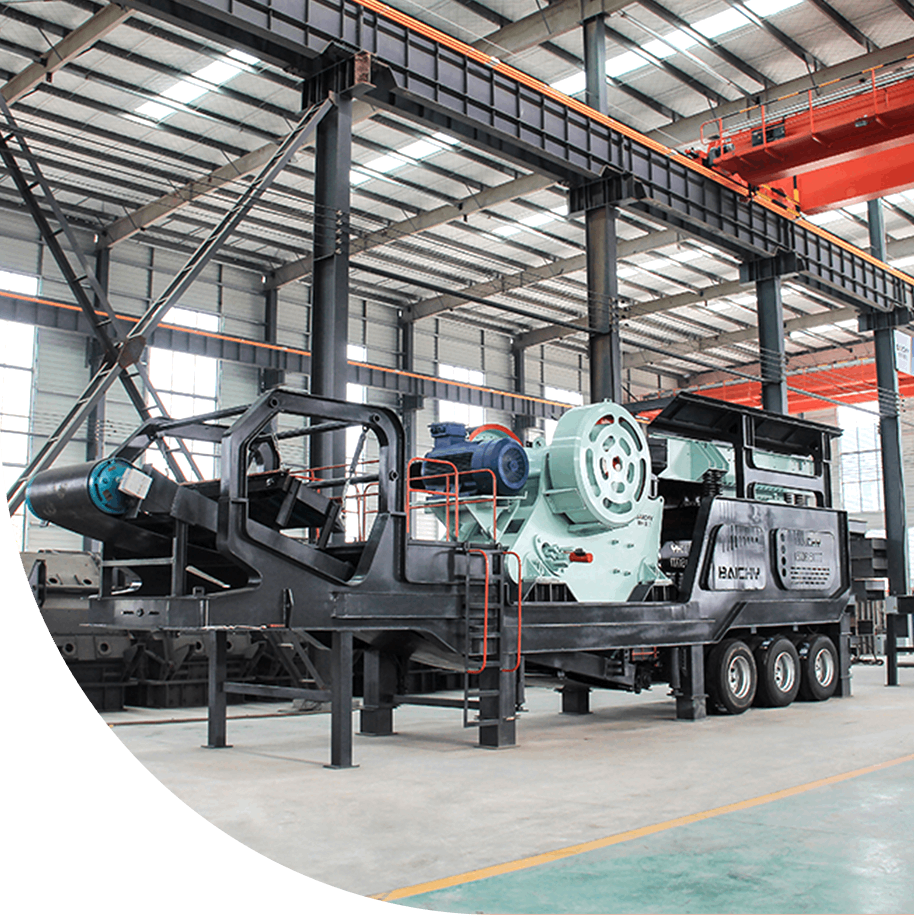
In the traditional fields of aggregate production and construction waste processing, fixed crushing production lines have long dominated. However, with increasing project dispersion, stricter environmental requirements, and higher demands for return on investment, a more flexible, efficient, and economical solution has emerged, sparking a "mobile mining revolution" globally – the mobile crushing plant.
I. What is a Mobile Crushing Plant?
A mobile crushing plant, as the name suggests, is a complete crushing and screening production line that integrates key equipment such as feeding, crushing, screening, and conveying onto one or more mobile chassis (wheeled or tracked). It overturns the traditional model of "transporting materials to the production line," realizing the operational concept of "the production line going to the material site," like a miniature factory that can move freely.
Mobile Jaw Crusher

Mobile Impact Crusher

Mobile Cone Crusher

Mobile Hammer Crusher

Mobile Sand Making Plant

II. Core Working Principles and Equipment Composition
A typical mobile crushing plant usually consists of the following core modules:
Feeding System: A vibrating feeder is responsible for uniformly and continuously feeding raw materials into the crusher.
Crushing System: The core part, where the main machine (such as jaw crusher, impact crusher, cone crusher, or vertical shaft impact crusher) is selected according to the crushing process, enabling coarse crushing, medium crushing, fine crushing, and even sand making.
Screening System: A multi-layer vibrating screen is used to classify the crushed materials according to different particle sizes. Unqualified materials can be returned for further crushing, forming a closed-loop cycle.
Conveying System: A group of belt conveyors connects each process step, enabling automated material flow.
Power and Control System: A diesel generator set or external power supply provides power, and an integrated electrical control system enables one-button operation and intelligent monitoring.
Mobile Chassis: Wheeled chassis offer flexibility and are suitable for factory areas or flat roads; tracked chassis have strong off-road capabilities, low ground pressure, and can be driven directly to complex and rugged work sites. III. Six Unparalleled Core Advantages
Extremely Flexible and Quick Relocation: No need for piling or fixed foundations; the equipment can be moved to new work sites at any time, making it particularly suitable for urban construction waste treatment, multiple dispersed construction projects, and small quarries, significantly reducing material transportation costs and time.
Rapid Commissioning and Investment Savings: Eliminates the need for large steel structures and foundation construction costs. The equipment can be put into operation immediately upon arrival, requiring less capital and offering a shorter return on investment period.
Integrated Operation and Excellent Efficiency: Integrates crushing, screening, and conveying, allowing a single machine to complete the production line tasks. The compact process flow reduces energy consumption and material loss in intermediate stages.
Strong Adaptability and Wide Application: Not only can it be used for crushing and sand production of natural rocks, but it is also a powerful tool for processing construction demolition waste and recycled asphalt pavement materials, achieving resource recycling and conforming to the concept of a circular economy.
Environmentally Friendly and Energy-Saving, Reducing Disturbance: It can operate directly at the raw material pile or demolition site, reducing noise, dust, and exhaust pollution caused by long-distance transportation from the source. Advanced dust removal and noise reduction designs further minimize environmental impact.
Intelligent Control and Simple Operation: Modern control system, requiring fewer operators, easy maintenance, and safe and reliable operation.
IV. Main Types and Selection Guide
By Driving Method:
Wheeled Mobile Crushing Station: Fast moving speed, requires a truck tractor for towing, and has higher road requirements. Suitable for projects with relatively flat sites and longer relocation distances.
Tracked Mobile Crushing Station: Equipped with its own track walking mechanism, strong off-road capability, and remote control operation. It can adapt to complex terrains such as rugged mountains and wetlands, making it a truly "all-terrain" equipment.
By Process Combination:
Single-Unit Combination (Independent Units): Such as separate mobile jaw crushers, mobile impact crushers, and mobile screening stations, allowing for flexible configuration through the combined operation of multiple devices.
Multi-Unit Combination (Integrated Unit): Integrates two or even three stages of crushing and screening into one mobile device, offering high integration and suitable for situations requiring high product particle shape requirements and complex processes. Selection Considerations: It is necessary to comprehensively consider factors such as raw material properties (hardness, moisture content, size), expected output, finished product specifications, site topography, budget, and long-term project planning. It is recommended to communicate in depth with professional equipment suppliers to obtain customized solutions.
V. Wide Range of Application Scenarios
Urban construction waste resource utilization sites
Temporary aggregate supply in linear engineering construction such as highways, railways, and water conservancy projects
Small and medium-sized quarries and river pebble sand production projects
Treatment of industrial solid waste such as mine tailings and metallurgical slag
Rapid cleanup and recycling of debris in disaster areas
Q: What are the main differences between a mobile crusher and a stationary crusher plant?
A: The key difference lies in mobility and setup time. A mobile crusher is a self-contained, movable unit that can be transported directly to the job site, requiring minimal foundation work. A stationary plant is fixed in one location, requiring substantial civil construction and is ideal for long-term, high-volume production at a single site. Mobile plants excel in multiple, temporary, or hard-to-access sites.
Q: Can a mobile crusher plant handle hard rocks like granite or basalt?
A: Absolutely. Modern mobile crusher plants are equipped with robust crushers like jaw crushers (for primary crushing) and cone crushers (for secondary crushing) specifically designed to process hard and abrasive materials. The key is selecting the correct crusher type and configuration for your specific material hardness and desired final product size.
Q: How do I choose between a wheel-mounted and a track-mounted mobile crusher?
A: Choose a wheel-mounted (tire-type) model if you need to move frequently between sites on public roads (with towing) and your working sites are relatively flat and stable. Choose a track-mounted (crawler-type) model if you work on rough, uneven, or soft terrain (like a demolition site or a mine), as they offer superior mobility and stability without the need for a truck head.
Q: Is a mobile crusher plant suitable for recycling construction and demolition (C&D) waste?
A: Yes, it is one of the most popular and efficient applications. Mobile crushers can be set up directly at demolition or construction sites to crush concrete, bricks, and asphalt on the spot. This turns C&D waste into valuable recycled aggregates for new construction, saving tremendous costs on transportation and landfill fees, and supporting environmental sustainability goals.
Q: What about the production capacity and investment cost compared to a fixed plant?
A: Mobile crusher plants offer a wide range of capacities, suitable for small to medium-large scale projects. While their maximum capacity per single unit might be lower than a large stationary plant, their overall cost-effectiveness in flexible scenarios is superior. The initial investment can be competitive or even lower when you factor in the eliminated costs of foundation work, installation, and extensive conveying systems. The primary financial advantage comes from drastically reduced material hauling costs and the ability to serve multiple revenue streams from one equipment investment.