In the fields of mining, aggregate production, and construction waste recycling, choosing the right crusher is the cornerstone of project success and efficient profitability. However, faced with the wide variety of equipment types on the market, many professionals feel confused: which machine is best suited to my materials and working conditions?
As a mining crushing equipment manufacturer with twenty years of experience in the industry, we deeply understand the complexity of this choice. An unsuitable piece of equipment can lead to low output, high energy consumption, substandard finished products, and even frequent equipment failures, resulting in huge economic losses. Therefore, this article aims to simplify the process by systematically outlining the working principles, performance characteristics, and core application scenarios of seven mainstream crushers. Based on our twenty years of project experience, we provide a clear selection logic to help you make informed investment decisions.
1. Jaw Crusher
As the "pioneer" of the crushing process, the jaw crusher is known for its robust structure and high reliability. It crushes materials through the periodic squeezing motion between the movable jaw and the fixed jaw. Its characteristics include a large feed opening, capable of handling giant rocks up to 1.5 meters in size, a relatively small crushing ratio (usually 4-6:1), and a coarser output particle size. Best application: Primary crushing stage, processing various hard and abrasive materials with compressive strength below 320 MPa, such as granite and basalt. It is the most common primary crushing option in both stationary and mobile crushing plants.

2. Cone Crusher
The cone crusher is the "main force" in the secondary and tertiary crushing stages, especially suitable for high-hardness materials. It achieves continuous compression and bending crushing of materials through the eccentric gyratory motion of the movable cone within the fixed cone. Its greatest advantages are high crushing efficiency, long wear part life, and stable operation. Using the principle of layered crushing, it produces well-shaped finished particles with low needle-like and flaky content. Best application: Secondary or tertiary crushing, processing high-hardness ores (such as iron ore, gold ore, granite), and scenarios requiring high output and stable particle shape.

3. Impact Crusher
The impact crusher is a versatile machine that uses impact energy to crush materials. A high-speed rotating rotor drives the hammer plates to strike the material, giving it tremendous kinetic energy before it impacts the impact plate or collides with other particles, resulting in crushing. Its characteristics include a large crushing ratio (up to 50:1 or more), excellent product particle shape (mostly cubic), and flexible control of output particle size by adjusting the rotor speed and the gap between the impact plates. Best applications: Medium and fine crushing of medium-soft materials (limestone, concrete, construction waste), and sand production or aggregate production for commercial concrete plants where high demands are placed on product particle shape.

4. Vertical Shaft Impact Crusher (VSI)
The VSI sand making machine is the "core equipment" for manufactured sand production. It uses the "stone-on-stone" or "stone-on-iron" principle, where material is accelerated and thrown out by a high-speed rotating impeller, then crushed and shaped by colliding with the surrounding liner or other particles. Its core value lies in efficient sand production and excellent particle shape optimization capabilities, easily processing small stones into high-quality manufactured sand that meets national standards. Best applications: Artificial sand production, aggregate shaping, and high-value mineral particle shape optimization; a powerful tool for increasing product added value.

5. Hammer Crusher
The hammer crusher is a highly efficient crushing equipment that achieves "one-time molding." Hammerheads hinged on the rotor rotate at high speed, impacting, shearing, and grinding the material, allowing it to reach the desired particle size in one pass. It has a simple structure, a very large crushing ratio, and high output. However, the hammerheads wear quickly, and it is not suitable for high-hardness, highly abrasive materials. Best applications: One-time medium and fine crushing of medium-low hardness, brittle materials (such as limestone, gypsum, coal, salt), widely used in the cement and chemical industries.

6. Roll Crusher
The roll crusher crushes materials by squeezing and shearing them between two counter-rotating rollers. It has a compact structure, less over-crushing, and uniform product particle size. It is mainly divided into double-roll crushers and four-roll crushers. Its processing capacity is relatively low, and the roller surface is prone to wear. Best Application: Fine crushing of brittle and viscous materials such as coal, coke, and sintered ore, or fine crushing processes with strict requirements on product over-crushing rate.

7. Mobile Crusher Plant
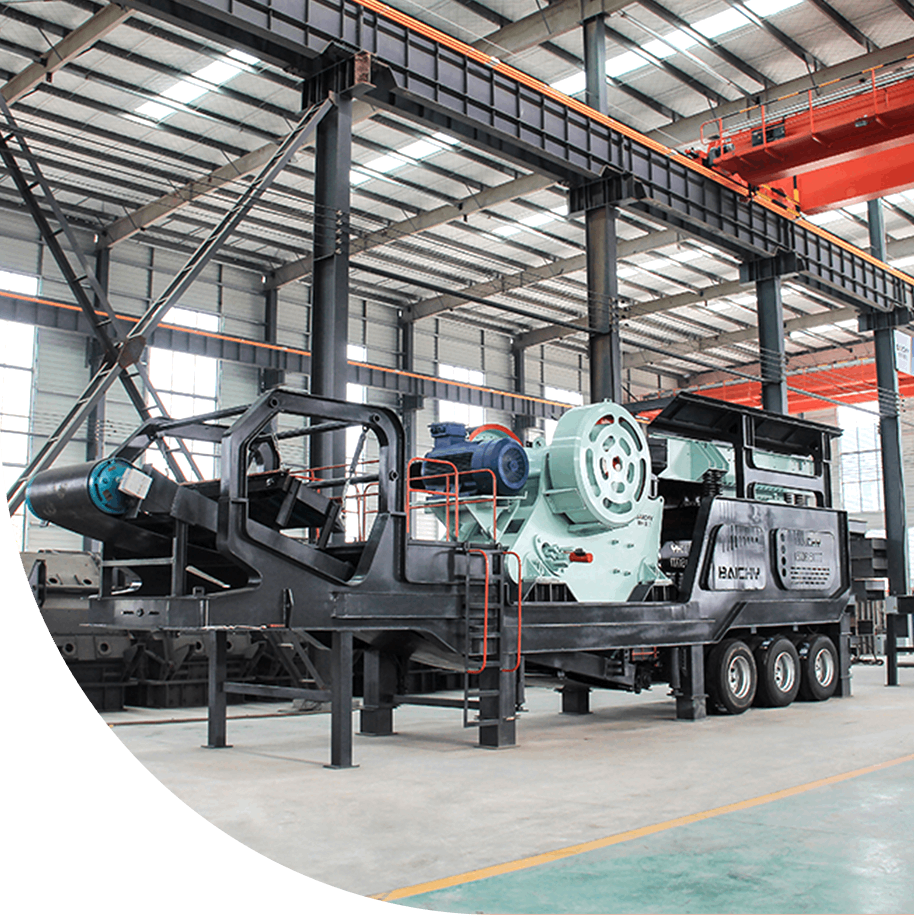
A mobile crusher is not a single type of crusher, but an integrated system that combines feeding, crushing, screening, and conveying. Its core feature is "mobility," and it can be equipped with any one or more of the above-mentioned main machines (such as mobile jaw crusher, mobile impact crusher, mobile cone crusher, etc.). It completely breaks through site limitations, realizing "where the material is, the factory is." Best Application: Construction waste resource utilization, urban demolition projects, small and medium-sized mines, multi-site projects, and projects requiring high flexibility and short cycles.

How to choose the best equipment?
Analyze material characteristics: This is the first and decisive step. Clearly define the material's hardness (Mohs hardness or compressive strength), abrasiveness, moisture content, viscosity, feed size, and final product requirements (particle size, particle shape, and gradation).
Determine production needs: Clearly define your target hourly/daily output, project operating cycle (short-term or long-term), investment budget, and expected operating costs.
Match the process flow: Based on material and product requirements, design a reasonable number of crushing stages (single-stage, two-stage, or three-stage) and process flow (open-circuit or closed-circuit). Generally, materials with high hardness and strong abrasiveness are suitable for the "jaw crusher + cone crusher" combination; medium-soft materials are suitable for the "jaw crusher + impact crusher" combination; and sand making requires the introduction of a VSI.
Consider working conditions and operation: Evaluate the work site (whether fixed, space size), environmental requirements (noise, dust), power supply situation, and subsequent maintenance convenience. For dispersed, short-term projects, a mobile crushing plant is a more economical choice.
Our Value: Twenty years of experience means that we not only sell equipment but also provide solutions based on a deep knowledge base. We can help you navigate the maze of technical parameters, comprehensively consider the total cost of ownership, and match you with the most economical and efficient crushing solution, avoiding the high costs incurred due to incorrect selection.
FAQ 1: You mentioned that "jaw crusher + cone crusher" is suitable for hard materials, and "jaw crusher + impact crusher" is suitable for medium-soft materials. Is this a fixed combination? Can we choose "jaw crusher + impact crusher" to crush granite?
Answer: This is not absolute, but it is the most reliable experience based on wear costs and operational efficiency. Theoretically, "jaw crusher + impact crusher" can crush granite, but we generally do not recommend it. The reasons are:
High wear cost: Granite is hard and highly abrasive, which will severely wear the hammer plates and impact plates of the impact crusher. The replacement cost of wear parts may be several times that of a cone crusher, leading to a sharp increase in per-ton production costs.
Output and stability: The impact crushing principle of the impact crusher results in significantly lower efficiency and output when processing high-hardness materials, and the rotor load is high, posing challenges to equipment stability.
Our suggestion: For hard rocks such as granite and basalt, "jaw crusher + cone crusher" is an economical and efficient combination that has been proven over 20 years. The cone crusher uses layered crushing, resulting in low wear part consumption, stable operation, and significantly higher long-term overall benefits. We will conduct testing and analysis based on your specific material samples to provide the most optimized solution.
FAQ 2: Our project budget is limited, and hammer crushers seem to be cheaper. Can we use them to replace two-stage crushing (such as jaw crusher + impact crusher) to save on investment?
Answer: This is a common misconception. Although the initial investment in a single hammer crusher may be lower, extreme caution must be exercised when choosing one, and strict prerequisites must be met:
Suitable materials are required: It is only suitable for medium-low hardness, brittle materials with a compressive strength below 150 MPa (such as limestone, gypsum, and coal). If the material hardness is too high or the silicon content is high, the hammer heads will wear out very quickly and require frequent replacement, resulting in actual operating costs far exceeding your expectations.
Product particle size requirements: The powder content in the product of a hammer crusher may be high. If you have strict requirements for the finished product shape and gradation, it may not be the best choice.
Our professional opinion: When investing in equipment, you should not only look at the initial price, but also at the per-ton production cost. We will help you conduct a comprehensive life cycle cost analysis. If your material and product requirements allow the use of a hammer crusher, it is indeed a cost-effective option; otherwise, forcing its use will lead to greater losses.
FAQ 3: What are the fundamental differences between crawler-type and wheeled mobile crushing plants when choosing a mobile crushing station? How to choose?
Answer: This is a core question that determines the applicable scenarios of mobile crushing plants.
Crawler Mobile Crusher:
Advantages: Comes with a crawler chassis, can move independently without a trailer, and is operated by wireless remote control, offering high flexibility. It can easily move around within the plant area and on rugged mining sites. High integration, quick commissioning after connecting to the power supply upon arrival.
Applicable scenarios: Projects with complex sites, requiring frequent relocation (such as construction waste treatment sites, multiple mining faces), and projects with extremely high requirements for commissioning speed.
Wheeled Mobile Crusher:
Advantages: Usually requires a semi-trailer tractor for movement, with faster and more compliant road travel speeds. Under the same configuration, the price is usually lower than that of the crawler type.
Applicable scenarios: Projects that move between different fixed construction sites, with infrequent transfers and long transfer distances.
How to choose: Ask yourself, "How often do I need to move my equipment?" If the answer is "very frequently" or "the site conditions are poor," choose the crawler type; if the answer is "once every few months, mainly on the road," the wheeled type is more economical.
FAQ 4: We want to produce high-quality manufactured sand. The blog mentioned VSI sand making machines. What is the difference between it and high-efficiency fine crushers (or "third-generation sand making machines")?
Answer: This is a key choice in the sand and aggregate industry. Although both are used for sand making, the principles and effects are different:
VSI Sand Making Machine (Vertical Shaft Impact Crusher):
Principle: Uses the "stone-on-stone" or "stone-on-iron" centrifugal impact crushing principle, where the material collides with other materials or with the liner.
Core Advantages: Excellent particle shape, producing sand with multi-faceted cubic particles, continuous gradation, adjustable fineness modulus, comparable to natural sand, and can greatly improve the performance of concrete and asphalt. High sand making efficiency, suitable for large-scale, high-quality sand production. High-Efficiency Fine Crusher (often called the "Third Generation"):
Principle: More like an improved hammer crusher with a fine crushing chamber and grinding plates, using "stone-on-metal" impact and grinding.
Features: Relatively low investment cost, but the resulting sand particle shape is slightly inferior, with potentially higher needle-shaped and flaky content, and relatively higher fine powder content.
Our Recommendation: If your goal is to produce high-value, high-quality manufactured sand for high-grade concrete or high-end building materials, VSI is undoubtedly the preferred choice. If the requirements for sand particle shape are general and the budget is strictly limited, you can consider a high-efficiency fine crusher. We will demonstrate the differences between the finished sand from both types of crushers through experiments.
FAQ 5: You emphasize that your 20 years of experience can help us with equipment selection. What is the specific process? What do we need to prepare?
Answer: Yes, we provide not only equipment but also "selection consulting services" based on our experience. A scientific selection process requires collaboration between you and us:
Information you need to provide (the more the better):
Material samples: At least 10-20 kg of representative raw stone samples – this is the most important.
Material report: If available, please provide data on hardness, compressive strength, SiO2 content, water content, etc.
Infeed and output: Maximum infeed size? Desired final product specifications and output (tons/hour)?
Site conditions: Site size, power supply, water source, environmental requirements, project timeline, etc.