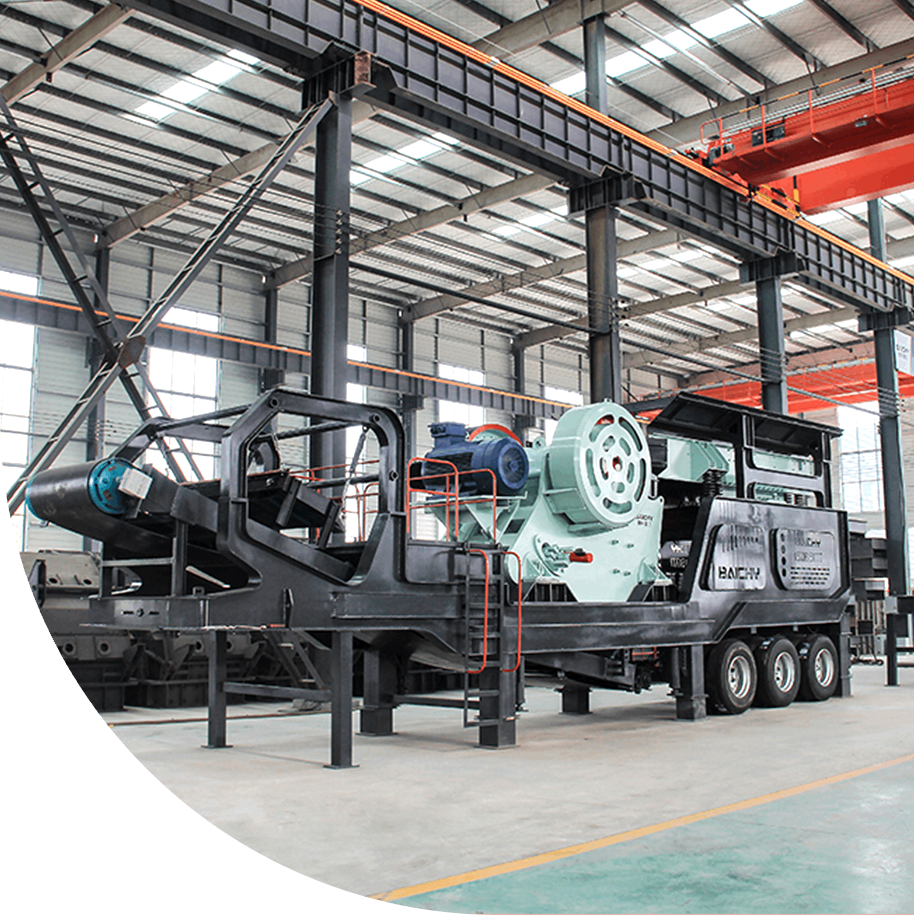
PE600x900 Jaw Crushing Line: Sizing What Comes After
A PE600x900 is the anchor of a small-to-medium crushing line, and it is usually chosen first. That order is backwards. The jaw does not set the line's output; its closed-side setting and the machines behind it do. Pick the jaw, then size everything else around a number you never decided, and the plant will spend its life at whichever stage turned out to be narrowest.
This article works from the jaw's two fixed dimensions outward: what it can be fed, what it can be set to, and what the rest of the line has to look like as a result.
I. Two Numbers Are Fixed at Purchase
In this model designation, 600 x 900 mm is the feed opening. That single figure decides the largest lump the line can accept, and it cannot be changed afterwards.
• The opening, not the crusher, limits the blast. A working rule is that the largest lump should sit around 80 percent of the opening or less. Above that, the machine bridges, stalls or takes the blow on the frame instead of on the rock.
• So the first question is about drilling, not equipment. If the quarry's blast produces boulders larger than the opening can take, the line needs a hydraulic breaker, a grizzly, or a different primary — not a bigger stockpile of excuses.
• Feed width matters as much as feed size. Material arriving in a narrow stream down one side of the chamber wears the jaw plates unevenly and reduces the effective opening.
• The second fixed number is the range of the closed-side setting. That range, not the tonnage on a brochure, is what you have to work with when the specification changes.

II. The Closed-Side Setting Is the Line's Throttle
Opening the jaw gives throughput and takes it out of the second stage. Closing it does the opposite. Neither is free, and the trade is the most common reason a line misses its design output in both directions.
• Open the setting and the jaw passes more tonnes, but coarser — so the secondary crusher receives more work and the return belt carries more oversize.
• Close the setting and the secondary is relieved, but the jaw's own capacity falls and its plates wear faster per tonne.
• The optimum is where the two stages are equally loaded, and it is found by measuring both — not by setting the jaw to the number on the drawing and leaving it.
• Wear moves the setting silently. As plates wear, the effective setting opens; a line that was balanced in month one is coarse and overloaded in month six.
Finding that balance costs an hour of measurement. Weigh or belt-scale the jaw discharge for twenty minutes, note the return belt load, then move the setting one step and repeat. Two steps in each direction will show you where the secondary starts to labour and where the jaw starts to starve — and that pair of observations is worth more than any single capacity figure in a brochure.
III. What the Rest of the Line Has to Be
| Component | What it decides | Common error |
| Vibrating feeder | Whether the chamber is fed a steady curtain | Sized on average rate, so surges bridge the jaw |
| Secondary crusher | The product curve and the circulating load | Chosen before the jaw's discharge is known |
| Screen | Top size, and how much comes back | Selected on product tonnes, not tonnes over the deck |
| Return belt | Whether the plant keeps running when screening slips | Sized on nominal output instead of peak recirculation |
| Surge bin | Whether a truck delay stops the crusher | Omitted, then blamed on the loader |
Every row in that table is downstream of a decision made on the jaw. That is why the line is designed from the setting outward rather than from the equipment list inward.

IV. Choosing the Second Stage
Behind a jaw of this size, the secondary is usually an impact crusher or a cone, and the choice follows the rock and the product rather than the tonnage.
• Impact crusher for limestone and similar rock where shape matters and abrasion is moderate. It gives a high reduction in one pass, which suits a two-stage line.
• Cone crusher for hard, abrasive feed where blow bar cost per tonne would dominate. It needs a controlled, graded feed and rewards a proper scalping step.
• A fine crusher or compound crusher where one product band is acceptable and the buyer wants to avoid a third stage — provided the feed is dry enough for the discharge design.
• Whatever is chosen, it must accept what the jaw actually delivers, at the setting the jaw is actually run at — not at the setting in the quotation.
V. Three Configuration Mistakes
• Sizing every machine on the same number. A jaw, a secondary and a screen each have a different usable capacity; treating them as equal guarantees a bottleneck.
• Forgetting the circulating load. In closed circuit the secondary handles the finished tonnage plus the returns. A line quoted at a nominal rate without that allowance has no headroom.
• Buying a screen for the product, not for the deck. Screens are loaded by everything passing over them, which in closed circuit is more than the product rate.
VI. What to Ask the Supplier For
• The jaw's capacity at a named closed-side setting, and at the next setting either way, so the throttle is visible.
• The discharge curve at that setting, because that curve is the secondary's feed, not the nominal setting.
• The largest lump the line will accept, stated as a dimension and traced back to the feed opening.
• A mass balance in finished tonnes, showing every stream including the return.
• Installed power per tonne of product, so two quotations can be compared on running cost rather than price.
• The plate and liner life in tonnes on material similar to yours.
VII. Two Figures to Record on Day One
• The setting, measured, not assumed. Plate wear means the number on the adjuster and the real gap are different things. Record the measured value and the date, so the next check has a baseline.
• The return belt load at design output. That single figure tells you how much headroom the circuit has, and it is the first number to look at when the line stops keeping up.
A line is not commissioned when it starts; it is commissioned when someone can say what it was doing on the day it worked.
Frequently Asked Questions About PE600x900 Lines
Q: What size of rock can a PE600x900 take?
A: The designation refers to a 600 x 900 mm feed opening, so the largest lump should be kept comfortably below that — commonly around 80 percent as a working limit. Measure the oversize your blast actually produces before ordering.
Q: How much does the line produce?
A: That depends on the closed-side setting, the rock, and how the stages behind it are matched. Ask for a capacity at a stated setting and a stated product, and treat any single figure without those qualifiers as unusable.
Q: Open circuit or closed circuit behind the jaw?
A: Closed, if you sell to a top-size specification. Open circuit passes whatever the chamber makes that day, and the top size drifts as plates wear.
Q: Is a jaw plus an impact crusher enough for two products?
A: Usually, with a screen dividing the impactor's discharge. Three or more sizes, or a shape requirement, pushes the plant towards a third stage.
Q: Why does the line make less than it did when new?
A: Plate wear opens the effective setting, so the secondary receives coarser feed and the return belt carries more. Check the setting before changing anything else.
For jaw crushers and matched line configurations, see the crushing plant range.