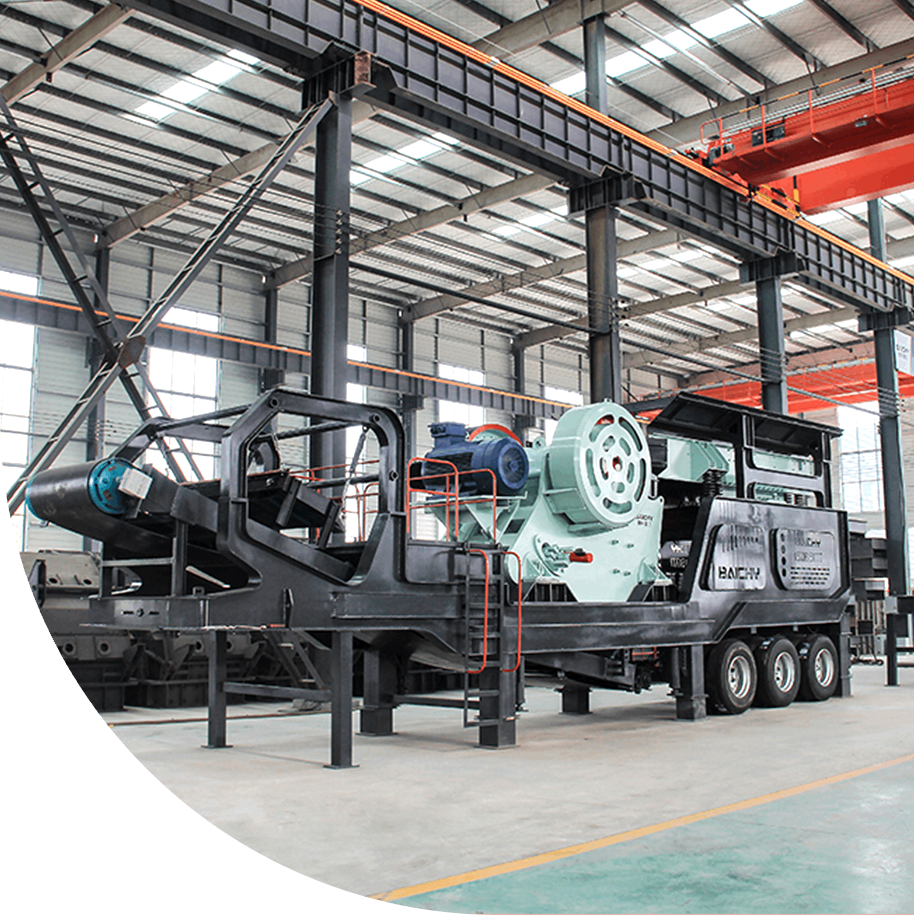
Modular Mobile Crushing Plant: Flexibility Without a Wheelbase
"Flexible" is usually read as "on wheels". That is one kind of flexibility — the ability to move tomorrow. There is a second kind, and for most quarries it is worth more: the ability to change capacity, configuration and product mix without building a new plant. That is what a modular plant sells.
This guide separates the two, shows where a skid-mounted plant beats a tracked one, and covers the part that decides whether the project succeeds — the interfaces between modules.
I. What "Modular" Actually Means
A modular plant is built as transportable units — skid frames or container-sized structures — that bolt together on site. There is no chassis, no axle, no undercarriage. The machine arrives on a flatbed, is lifted into place by crane, and is connected to its neighbours.
• Structure. Steel skid or container frame, designed for lifting and for transport loads, not for towing.
• Connection. Bolted flanges and pinned joints, with conveyors and chutes split at module boundaries.
• Foundation. A prepared pad or simple concrete footings. This is the practical difference from a tracked plant, which needs only ground pressure capacity.
• Power. Usually electric, which removes the engine, the fuel tank and a maintenance item — at the cost of a cable and a supply.
II. Three Answers to "We Might Move It"
| Configuration | Moves how often | Setup | Best fit |
| Tracked | Weekly or monthly | Hours, no crane | Short faces, demolition, contract work |
| Wheeled | Between nearby sites | Towing plus levelling | Road-legal relocation, small plants |
| Modular | Once every few years | Days, with crane and pad | Long-life reserves, phased capacity |
The honest test is relocation frequency. If the plant will move more than a few times a year, an undercarriage is cheaper than a crane. If it will move once every three to five years, paying for tracks you rarely use is the wrong purchase — and you carry that cost in maintenance, fuel and reduced deck area for the whole life of the machine.

III. What Modularity Buys You
1.Capacity in steps, not in one decision
Start with primary and one screen; add a secondary module when the market justifies it. Capital follows demand instead of anticipating it — which is a very different risk profile from a fixed plant built for a forecast.
2.Parallel fabrication and installation
Modules are built and tested in a workshop while the civils are done on site. Commissioning becomes a sequence of connections rather than a construction project.
3.Maintenance by substitution
A worn module can be lifted out and replaced, with the swap planned into a shutdown. On a monolith, the same repair is a site fabrication job.
4.No undercarriage to maintain
Tracks, rollers and final drives are wear items with a defined life. Removing them removes a maintenance category, and it removes the weight and cost that come with them.
5.Shipping and redeployment
Modules designed to standard transport envelopes can be shipped in containers and reassembled elsewhere — relevant when the plant may end up in a different country or on a different contract.

IV. What It Costs You
• A crane and a pad. Neither is free, and both need planning. On a remote site, mobilising a crane can dominate the schedule.
• Bolted joints need discipline. Vibration loosens what was not torqued to specification. A modular plant's reliability is mostly a documentation problem: torque values, sequences and re-checks.
• Dust and water containment are harder. Chutes and conveyors split at module boundaries, and every split is a potential leak point.
• Not for rapid relocation. Days, not hours. If the plan says "move it next weekend", that plan is for a tracked machine.
• Footprint is fixed, so layout errors are expensive to correct once the pad is poured.
V. Where a Modular Plant Wins
• A quarry with a long reserve but an uncertain market. Build for today's demand, add modules as it grows.
• Multi-year contract crushing, where the plant stays for the contract and then moves once.
• Satellite pits fed from a central hub, with capacity rotated between locations.
• Sites with grid power, where an electric plant removes fuel logistics entirely.
• Markets with import or transport constraints, where container-sized modules are the only practical way to deliver a plant.
VI. The Interfaces Decide the Project
Most modular projects that go wrong do not fail inside a module. They fail between them. Confirm these before signing:
• Transport envelope and module weight per unit, including the heaviest lift and the crane class required.
• Lifting points and rigging plan, agreed in writing rather than improvised on site.
• Foundation loads and anchor layout for each module, including dynamic loads.
• Belt and chute connection tolerances, and who is responsible for aligning them on site.
• Electrical scheme and control philosophy: one MCC or several, and how interlocks are proven.
• Commissioning responsibility — a named party for the first tonne, not a shared assumption.
Frequently Asked Questions About Modular Crushing Plants
Q: Is a modular plant the same as a mobile plant?
A: No. Mobile plants carry their own undercarriage and can reposition themselves; modular plants are lifted and bolted. Both are relocatable, but on very different timescales and with different site requirements.
Q: How long does erection take?
A: Days to a few weeks depending on module count, crane availability and how much civils work is ready. The critical path is usually the pad and the power supply, not the steel.
Q: Can modules be added later to raise capacity?
A: That is the main commercial argument — provided the original layout reserved space, headroom and power capacity for them. Adding a module to a plant that was laid out without one is a redesign, not an upgrade.
Q: Electric or diesel?
A: Electric where supply exists: lower running cost and fewer wear items. Diesel or hybrid where the site is remote or the supply is unreliable. Decide on the site, not on the brochure.
Q: What is the main risk in a modular project?
A: Interface management. Module design is usually sound; the failures happen in alignment, anchoring, cabling and the assumption that the other party has checked the joint.
For module configurations, transport dimensions and layout options, see the modular crushing plant range.