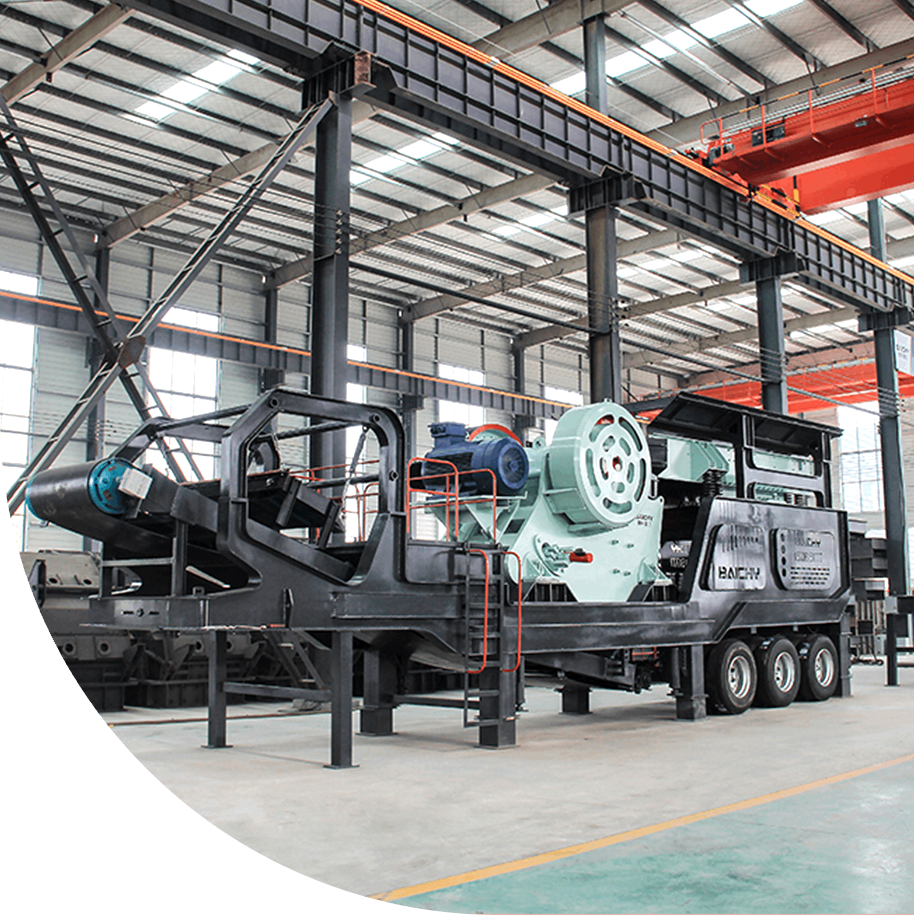
200 t/h Jaw and Cone Crushing Line: Setting the Ratio
A 200 t/h jaw and cone circuit is the standard answer for hard rock, and it is also where more plants are misconfigured than anywhere else. Not because either machine is wrong, but because the pair only works if the reduction ratio is divided between them deliberately — and at this output the division lands right on the boundary between a standard cone and a short-head.
This article works from the ratio budget outward: what the jaw can take, what the cone must finish, which chamber that implies, and what the belt between them does to both.
I. Start With the Ratio Budget, Not the Tonnage
Before any model number, two figures decide the circuit: the largest lump you feed, and the largest particle you are allowed to sell. Divide one by the other and you have the total reduction the plant must achieve.
Use your own figures — the method is what matters. A quarry feeding 500 mm and selling 0-40 mm is asking for roughly twelve to one. As a working rule, a jaw crusher delivers something in the region of four to six to one; a cone in closed circuit delivers roughly three to four. Twelve to one is therefore just inside what two machines can do, and only if both are set up for it.
• Well inside two stages — a generous product size or a smaller feed lets a standard cone finish the job comfortably.
• At the edge — the two-stage circuit works, but there is no room for a chamber chosen for the wrong reason.
• Past the edge — ask for 0-20 mm or manufactured sand from the same feed and two stages will not hold the specification at this output.
• The ratio, not the tonnage, tells you how many stages. Two plants at 200 t/h with different products need different circuits.

II. What the Jaw Can Carry
The jaw's contribution is set by its feed opening and its closed-side setting, and both are fixed at purchase. That is why the jaw decision is the one you cannot revisit later.
• Feed opening against the largest lump. A common working limit is that the largest lump should sit around 80 percent of the opening or less. Design at the limit and every oversize boulder becomes a stoppage.
• Closed-side setting against the cone's feed. The jaw's discharge is the cone's feed. Set the jaw coarse to gain tonnage and the cone receives material it must reduce further; set it fine and the jaw's own capacity falls.
• Full chamber, continuous feed. A jaw fed in batches produces a coarser, flakier discharge and wears its plates unevenly. At 200 t/h the feed arrangement is part of the metallurgy.
• The jaw sets the shape of everything downstream. A slabby discharge packs differently on the cone's feed belt and screens less efficiently than a cubical one.
III. Standard or Short-Head: The Only Real Decision
At this output, this is the question that decides whether the plant meets its specification. The two chamber families are not quality grades; they are different positions on a trade between capacity and reduction.
• Standard cone — large feed opening, high throughput, coarser product. It is the natural second stage behind a jaw, and in closed circuit with a screen it will make a saleable product for most aggregate specifications.
• Short-head cone — small feed opening, finer product, lower capacity for the same head size. It is a finishing machine, and it needs a screened, controlled feed.
• Changing the cavity is not free. A finer cavity in the same machine gives a finer product and a lower tonnage. A quoted capacity belongs to a particular chamber and setting, not to the model.
• The classic mistake is choosing a short-head to reach a finer product, then discovering the 200 t/h figure belonged to the standard chamber. The plant then runs below its stated output for the rest of its life.
| Configuration | Where it lands on the ratio | Product | Watch out for |
| Jaw + standard cone, open circuit | Comfortable for coarse products | One or two sizes, wider tolerance | Oversize passes; no control of top size |
| Jaw + standard cone, closed circuit | At the working edge | Two or three sizes to specification | Circulating load raises the cone's real duty |
| Jaw + short-head, closed circuit | Fine product, less capacity | Finer sizes, tighter band | Throughput falls; feed must be screened |
| Jaw + standard + short-head | Beyond two stages | Fine sizes plus shape control | Third machine, third belt, third failure point |
Read the second and third rows together. They describe the same tonnage claim reached two different ways, and only one of them will hold the specification you actually sell.
IV. The Belt Between Them Is a Machine Too
The conveyor from the jaw to the cone is where the two machines are reconciled, and it is usually where the circuit loses its tonnage.
• Scalp the fines before the cone. Material already below the product size does not need to pass through the chamber; removing it raises the cone's effective capacity and reduces the packing that causes power spikes.
• Keep the feed graded. A cone fed a narrow band of one size produces a poorer shape and a less stable power draw than one fed a graded mix.
• Do not let the chute become the choke. A transfer that cannot pass the jaw's peak discharge throttles the cone before the cone is anywhere near its limit.
• Metal before the cone. A magnet and a detector on this belt cost a fraction of a cone rebuild, and this is the belt where tramp metal arrives.

V. Closed Circuit Changes the Number You Asked For
At 200 t/h almost every aggregate plant runs closed circuit, and that means the cone does not process 200 tonnes an hour. It processes the finished tonnage plus whatever the screen returns.
So the cone must be selected on its circulating duty, not on the nameplate figure. Specify the return share you are designing for, ask what the cone carries at that share, and check that the return belt and the screen were sized on the same number. Where those three figures disagree, the plant's real output is the lowest of them.
VI. What to Ask the Supplier For
• The reduction ratio split between the two machines, stated explicitly, with the feed size and product size it assumes.
• Capacity quoted at a named chamber and setting — and the capacity at the next finer chamber, so the trade is visible.
• The design circulating load, and the cone's duty at that load rather than at the headline figure.
• Maximum feed size into the cone, compared with the jaw's actual discharge curve rather than its nominal setting.
• Wear parts priced per tonne, for both machines, on your rock.
• A mass balance in finished tonnes, showing every stream including the return.
Frequently Asked Questions About 200 t/h Jaw and Cone Lines
Q: Is 200 t/h achievable with one jaw and one cone?
A: Usually yes for a coarse or medium product from a moderate feed size. The limit is the total reduction ratio, not the tonnage — ask for the ratio split before accepting a capacity figure.
Q: Should the cone be standard or short-head?
A: Standard if the product band is moderate and capacity matters; short-head if the product is genuinely fine and you accept a lower throughput for the same head size. Do not choose short-head to fix a problem the screen should solve.
Q: Do I need a screen between the jaw and the cone?
A: A scalping screen is worth it in most hard-rock plants, because fines that bypass the cone raise its effective capacity and reduce packing. It also protects the chamber from a feed that is too fine.
Q: Why is my plant producing less than the quoted 200 t/h?
A: Three usual reasons: the capacity was quoted for a coarser chamber, the circulating load was never added to the cone's duty, or the feed is finer or wetter than the design assumed. Check the ratio split first.
Q: Can the same plant sell 0-40 mm and 0-20 mm?
A: Yes, by changing screen apertures and closing the cone, but not at the same tonnage. Every step towards a finer band costs capacity, so quote the two products separately and price the plant on the finer one.
Q: When does a third stage become necessary?
A: When the product is fine enough that a short-head cannot hold capacity at this tonnage, or when shape has to be controlled — that is a vertical shaft impactor, not a fourth cone setting.
For jaw and cone combinations in this capacity band, see the crushing equipment range.