Aggregate producers processing granite, basalt and andesite face continuous challenges related to high material hardness, abrasive wear and production downtime. In medium- and large-scale crushing plants, frequent liner replacement, chamber blockages and unstable production can significantly increase operating costs. As a result, producers are increasingly focusing on cost per ton, equipment availability and long-term operating efficiency when selecting secondary and tertiary crushing equipment.
Hydraulic cone crushers are widely used for secondary and tertiary crushing of hard and abrasive rock. Their compression crushing principle efficiently reduces material while maintaining stable operation under demanding conditions. Optimized crushing chambers, eccentric movement and adjustable discharge settings allow operators to control the final product size according to different aggregate requirements. This makes hydraulic cone crushers suitable for applications involving granite, basalt, andesite and other high-strength materials.
I. Optimized Crushing Chambers Help Control Wear Costs
For hard-rock applications, the design of the crushing chamber and liner profile has a direct influence on wear-part consumption and crushing performance. A properly selected chamber maintains effective rock compression and improves material distribution throughout the crushing zone. By matching the crusher chamber, liner configuration and feed characteristics, producers can achieve more consistent crushing performance and potentially reduce unnecessary wear-part consumption over the operating cycle.
II. Hydraulic Adjustment Improves Operational Flexibility
Hydraulic adjustment systems allow operators to control the crusher’s closed-side setting more conveniently according to production requirements. Hydraulic overload and tramp-release functions can also help protect the equipment when uncrushable material enters the crushing chamber. Compared with traditional mechanical adjustment systems, hydraulic designs can simplify setting adjustment and maintenance procedures, helping reduce interruptions and improve equipment availability.
| Parameter |
Specification / Description |
| Application |
Secondary and tertiary crushing |
| Material |
Granite, basalt, andesite, river pebble and other hard rocks |
| Crushing Principle |
Compression crushing |
| Adjustment |
Hydraulic adjustment |
| Overload Protection |
Hydraulic overload and tramp-release system |
| Product Application |
Concrete aggregate, asphalt aggregate, road base and manufactured sand production |
| Recommended Configuration |
Jaw Crusher/Cone Crusher/Vibrating Screen/Return Conveyor |
III. Stable Product Size Supports High-Quality Aggregate Production
Product shape and particle-size distribution are important factors in concrete, asphalt and road construction applications. When correctly configured and operated, cone crushers can produce consistent aggregate sizes suitable for downstream screening and further shaping. For projects requiring higher particle-shape quality, a VSI sand-making machine can be added after the cone crusher to further improve aggregate shape and manufacture high-quality sand.
IV. Cone Crusher Integration Improves Complete Plant Performance
A
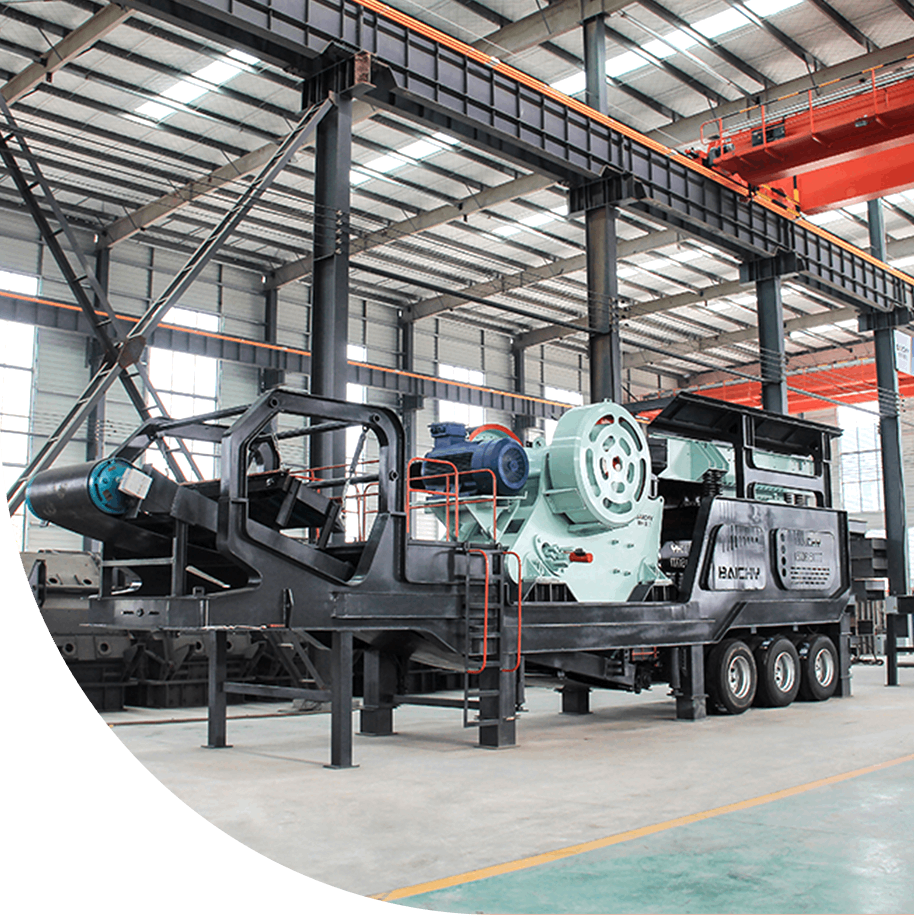
cone crusher performs best when properly matched with the upstream jaw crusher, vibrating screen and return conveyor. A typical hard-rock configuration may use a jaw crusher for primary reduction, a hydraulic cone crusher for secondary crushing, and a vibrating screen for product classification, with oversized material returned to the cone crusher for further processing. Proper equipment matching helps balance feed capacity, crushing load and screening efficiency across the complete production line.
Choosing a suitable cone crusher requires consideration of raw material hardness, abrasiveness, feed size, required capacity, final product size and operating conditions. Producers should evaluate equipment performance using actual material data rather than relying only on nominal capacity figures. Baichy can provide customized crushing plant configurations based on project requirements, helping customers select appropriate jaw crushers, cone crushers, vibrating screens and auxiliary equipment for hard-rock aggregate production.
Frequently Asked Questions About the Complete Grinding Production Line
Q: What materials are suitable for hydraulic cone crushers?
A: Hydraulic cone crushers are suitable for hard and abrasive materials such as granite, basalt, andesite, river pebble and various mineral ores.
Q: What is the difference between a hydraulic cone crusher and a spring cone crusher?
A: Hydraulic cone crushers generally provide more convenient hydraulic adjustment, overload protection and tramp-release functions, while spring cone crushers use mechanical spring systems for overload protection and adjustment.
Q: Can a cone crusher produce aggregate for concrete and asphalt?
A: Yes. With the appropriate crushing chamber, liner configuration and operating parameters, a cone crusher can produce consistent aggregate sizes for concrete, asphalt and road construction applications.
Enhance Your Material Handling Efficiency Today – Contact Our Experts for Customized solutions.