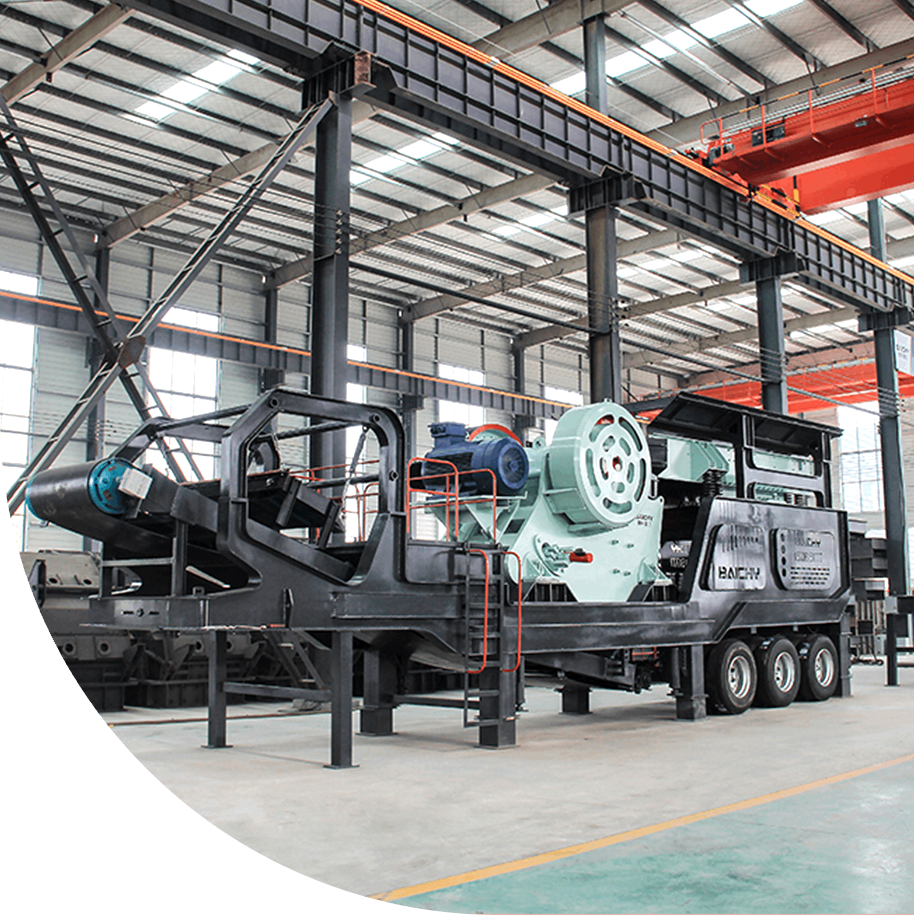
Can a Tracked Mobile Cone Crusher Work in Extreme Terrain Mining?
Yes — but not because the machine is built for extreme terrain. A tracked mobile cone crusher works in remote, high-altitude and steep-access mining because the site has been prepared for it: a stable bench, a haul road, and a feed that arrives at a controlled rate. Where those three conditions are missing, tracks do not compensate for them.
This article separates what the machine genuinely handles from what people assume it handles, and shows what has to be built before a mobile cone can produce on a difficult site.
I. The Limit Is Usually the Site, Not the Crusher
Cone crushers are not tolerant machines. They need a steady, evenly distributed feed and a chamber that stays full. A tracked chassis solves the transport problem – it does not solve the feed problem.
That distinction matters in remote mining. A mobile cone that arrives on site in a day still needs:
• A level working platform that carries the machine's weight without tilting.
• A feed method that spreads material around the chamber instead of dropping it in one spot.
• A discharge path for the product – conveyor or stockpile space, not a slope.
On a prepared bench, all three exist. On a hillside, none of them do, and the machine will run badly no matter how capable it is on paper.

II. What a Tracked Cone Crusher Genuinely Handles
1.Gradient and ground bearing
A crawler undercarriage can reposition itself on uneven ground and climb gradients for travel. That is not the same as producing on a slope. Production requires the machine to sit level; climbing is limited and model-specific, and should be checked against the specification rather than assumed.
Soft ground is the more common failure. Tracks sink, the frame tilts, feed distribution shifts to one side of the chamber, and liner wear becomes uneven within weeks. Timber mats or a compacted pad usually solve it more cheaply than a larger machine.
2.Altitude and temperature
Diesel engines lose output as altitude rises, and cooling capacity tightens as ambient temperature rises. A unit rated for sea level will not deliver the same throughput at 3,000 metres, and the gap is set by the engine, not by the crusher.
Ask for the derating curve before ordering, and confirm that the hydraulic system and the control cabinet are rated for the site's temperature range. Cold starts need the right oil grade and, on some sites, pre-heating.
3.Feed control on a moving face
On a narrow bench, an excavator often cannot feed the hopper evenly. Material lands in one corner, the chamber loads unevenly, power draw spikes, and the product gradation drifts. A pre-screen or scalper ahead of the chamber, plus a wider feed opening, fixes more of this than any increase in engine power.
| Site Condition | What the Machine Needs | Practical Fix |
| Steep or uneven ground | A level, compacted working platform | Cut a bench; use graded fill and compaction testing |
| Soft or muddy floor | Ground bearing capacity under the tracks | Timber mats, geotextile, or a crushed-rock pad |
| High altitude | Engine output matched to site conditions | Request the derating curve; size on site output, not sea-level rating |
| Uneven feed from excavator | Even distribution around the chamber | Pre-screen or scalper, wider hopper, feed control plate |
| Narrow mountain access | Road legal transport envelope | Check width, height and axle load; plan modular transport |
| Remote maintenance | Parts and lifting access | Spare liner set on site, service agreement, lifting plan |
III. Where the Machine Stops Working
A tracked mobile cone is the wrong choice in four situations:
• No bench can be built. If the ore body is a steep face with no room to level, the machine cannot work at production rate.
• Ground cannot carry it. Deep mud, tailings, uncompacted fill — the unit will sink or tilt.
• The road cannot take it. Transport width, height and weight are fixed limits on mountain roads and bridges.
• No service access. Liner changes need lifting capacity and space. A site where a crane cannot reach the machine turns a two-day job into a two-week one.

IV. Tracked Mobile or Stationary Plant in Remote Mining?
The deciding factors are life of mine, haul distance and whether a bench can be built at all.
Choose tracked mobile when the working face moves, the contract is short, or hauling raw material to a fixed plant costs more than crushing it on site.
Choose a stationary or modular plant when the site will run for years at steady tonnage. A fixed installation with a larger chamber and a proper screening plant will win on cost per tonne, and the civil works are paid back over the life of the mine.
Choose neither when the ground cannot be prepared. In that case the answer is a different mining method, not a different crusher.
Frequently Asked Questions About Tracked Mobile Cone Crusher
Q: What materials can the tracked mobile cone crusher process?
A: It is mainly used for hard rocks such as granite, basalt, river pebble, and iron ore with high abrasion resistance.
Q: Does it require a concrete foundation?
A: No. The crawler chassis allows direct operation on natural ground without foundation construction.
Q: How fast can the equipment be deployed?
A: It can be operational within a few hours after arriving on site, depending on configuration and site conditions.