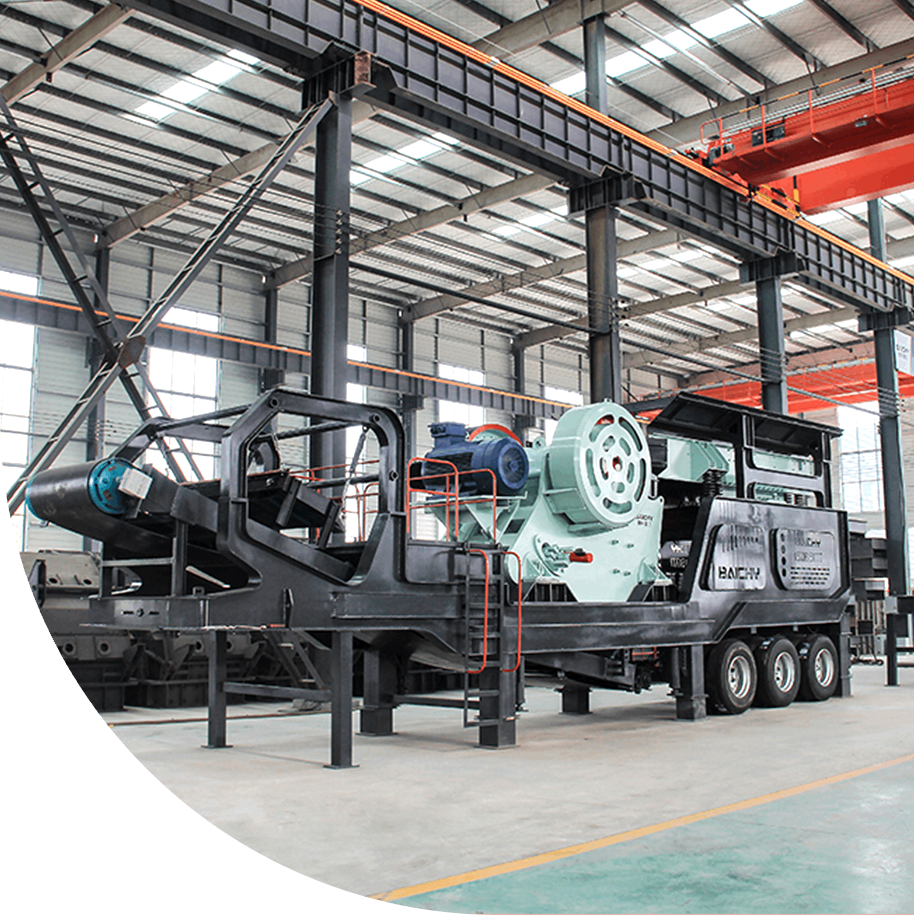
Crushing and Grinding Line: Crush More, Grind Less
Crushers and mills do the same job with very different efficiency. A crusher applies a concentrated force and breaks a particle; a mill throws media at a bed and spends most of its energy as heat, noise and deformation that never becomes a fracture. So every millimetre of reduction you move from the mill into the crusher is bought at a lower price — and that single fact should set the design of the whole line.
This article covers what the crushing stage owes the mill, how to choose between mill families, and why the classifier and the dust collector decide the output as much as the mill does.
I. The Rule the Whole Line Is Built Around
Comminution is the most energy-hungry part of a mineral plant, and grinding takes the largest share of it. That is not a detail of equipment selection; it is the economics of the plant.
• Crushing is efficient where it is used properly. Force is applied to a particle, and the particle breaks along its weaknesses.
• Grinding is inefficient by nature. Media collide with a bed, and only a fraction of those collisions produce a fracture in the size range you want.
• Therefore the cheapest tonne is the one the mill never has to reduce. Push the size down in the crusher, and the mill's job becomes finishing rather than bulk reduction.
• The rule has a limit. Crushing too fine is also wasteful — crushers lose efficiency and capacity as the target size falls, and some rock does not break well in a compression chamber. The optimum sits where the marginal cost of crushing equals the marginal cost of grinding.

II. Feed Size Is the Mill's Real Capacity Control
A mill's output is not set by its motor alone. It is set by how much of the grinding volume is doing fine grinding and how much is still working on coarse particles.
• Coarse feed borrows volume. In a ball mill the first chamber spends its length on impact work; the longer that takes, the less length is left for attrition and the finer the cut has to be pushed to compensate.
• Fineness becomes unstable. With coarse feed the product swings with every change in feed rate, and the operator ends up over-grinding to stay inside specification.
• Circulating load climbs. Coarser mill discharge means more returns from the classifier, which means more tonnes through the mill for the same finished output.
• So a capacity figure is meaningless without an inlet size. Ask for the mill's output at the feed size and fineness you actually intend, on one line, and treat any other figure as advertising.
III. What the Crushing Stage Owes the Mill
• A stated top size, held tightly. The mill reacts to the largest particle, not the average. A curve with a small oversize tail produces power spikes, liner wear and fineness drift out of proportion to its tonnage share.
• Closed circuit, not open. A screen returning oversize is how top size is guaranteed. In open circuit the crushing stage delivers whatever the chamber happens to make that day.
• Metal removal ahead of the mill. A broken tooth, a piece of drill steel or a bucket edge damages liners and can crack a mill shell. The magnet belongs before the mill, not only before the crusher.
• Moisture control. Dry grinding circuits need feed inside a moisture band; wet feed blinds screens, coats media and stalls a vertical mill. If the deposit is damp, drying is part of the line design, not an accessory.
• A steady rate. A mill wants a constant bed. Starved running means media striking liners instead of material — noise, wear and heat, with nothing produced.

IV. Choosing the Mill Family
| Type | Strength | Limit | Fits when |
| Ball mill | Highest fineness, tolerant of hard and abrasive feed, wide feed size range | Highest power per tonne, large footprint, foundation and media handling | Hard rock, high fineness, variable feed |
| Vertical roller mill | Lower power per tonne, drying and classifying built in, compact | Sensitive to abrasion and to vibration; tighter feed size requirement | Dry feed, medium fineness, power cost matters |
| Pendulum (Raymond) mill | Low capital, simple operation, good for small and medium output | Output falls steeply as fineness rises; upper fineness band limited | Soft to medium material, moderate fineness |
None of these is better in the abstract. The comparison that matters is power per tonne at your fineness, on your material, with your moisture — and that number should be asked for rather than inferred from motor size.
V. The Classifier and the Collector Are Half the Line
• The classifier sets the top cut and the circulating load. A weak separator either returns finished product to the mill — over-grinding, paid for in power — or lets coarse particles through to the product.
• In a grinding line, the dust collector is the product recovery device. The finished powder leaves in the air stream; collection efficiency is yield. A collector that is undersized or leaking is a production loss first and an environmental issue second.
• Air volume is a capacity figure. Filtration area and air-to-cloth ratio decide whether the collector keeps up at peak, and whether the mill has to be throttled on a humid day.
• Recovered dust has to go somewhere. A screw conveyor or air slide sized below the collector's discharge rate turns a good collector into a bottleneck.
VI. Where These Lines Usually Fail
• The crushing stage is sized on the quarry, not on the mill. The mill is the constraint in a grinding line, so the crusher is specified to serve it, not to match the pit.
• No buffer between them. Crushing is intermittent; a mill runs continuously and restarts slowly. Without surge capacity, every crusher stoppage becomes a mill stoppage.
• Interlocks written after commissioning. Mill start sequence, feed interlock on bearing temperature, high-level protection in the bin — each one is cheaper as a drawing than as a breakdown.
• Access ignored. A ball mill needs a route for adding media and for liner changes; a vertical mill needs space to lift the roller assembly. Both are layout decisions made once.
• Dust handled as an afterthought. A collector added at the end of the project is a collector sized on a guess.
VII. What to Ask the Supplier For
• Mill output quoted at a stated inlet size and fineness, both on the same line, for your material.
• Specific power in kWh per tonne at that fineness, so two quotations can be compared on running cost.
• The crushing stage's guaranteed top size, with the screen arrangement that enforces it.
• Classifier type and how the cut point is adjusted in service, not at the factory.
• Collector sizing basis and guaranteed outlet concentration, plus the air volume at peak.
• Liner and media consumption per tonne, and the maximum feed moisture the circuit accepts.
Frequently Asked Questions About Crushing and Grinding Lines
Q: How fine should the crushing stage go?
A: As fine as the mill's specified inlet allows, with the top size held tightly by a screen. Ask the mill supplier for the maximum feed size and the tolerance on oversize — that number, not a general rule, sets the crusher setting.
Q: Ball mill or vertical mill?
A: Compare on power per tonne at your fineness, then on moisture and abrasion. A vertical mill usually wins on power and footprint; a ball mill wins on tolerance of hard, abrasive or variable feed.
Q: Why does the mill not reach its rated output?
A: In order of likelihood: feed coarser than the rating assumed, moisture above what the circuit can handle, a classifier returning finished product, or a collector that cannot carry the air volume at peak.
Q: Is a surge bin really necessary between crushing and grinding?
A: Yes in almost every case. Crushing stops for blockages, liner checks and shift changes; a mill does not restart instantly. The bin converts those stoppages into stored feed rather than lost production.
Q: Can the line switch between fineness grades?
A: Within the mill's range, yes — by adjusting the classifier cut and the feed rate. Each grade has its own output, so the tonnage at your finest grade is the figure the plant is really worth. Changeover is quicker on a vertical mill than on a ball mill.
Q: How much does the dust collector affect output?
A: In a dry grinding line it is the product collection point, so its efficiency is the yield. Undersized filtration area shows up as visible dust, lost product and a mill that has to be run slower in humid weather.
For crushers, mills and classifiers matched to a grinding circuit, see the grinding plant equipment range.