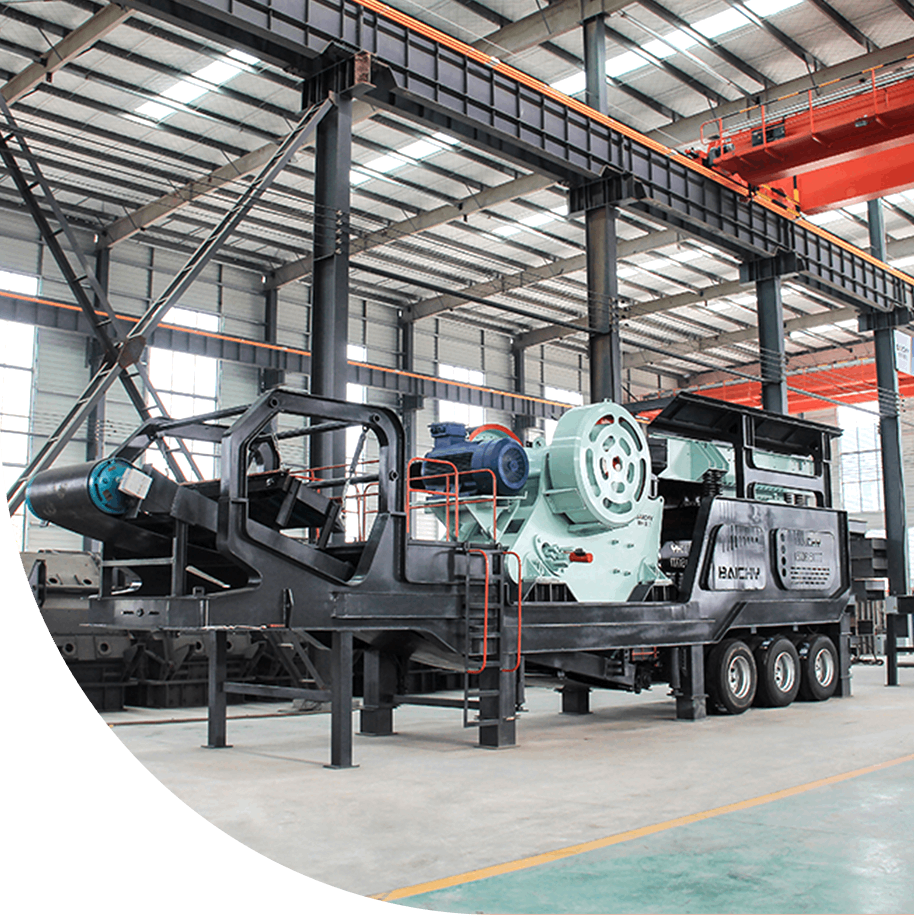
In a crushing production line, jaw crushers and cone crushers are often used together for maximum efficiency. Jaw crushers are primary crushers that handle larger, bulkier materials, while cone crushers are secondary crushers that provide finer crushing. The combination of these two types of crushers enables the production of uniform-sized, high-quality aggregates, which are essential for construction, road building, and other applications.
I. How Jaw Crushers Work in a Production Line
Jaw crushers are typically the first step in a crushing production line. They work by using a pair of jaws that compress material between them. One jaw is stationary while the other moves back and forth. This motion allows the material to be broken down into smaller pieces as it is crushed. Jaw crushers are designed to handle large, hard materials, such as rocks, ores, and construction debris, making them ideal for the first stage of the crushing process.

II. How Cone Crushers Work in a Production Line
Cone crushers are used as secondary crushers in a crushing production line. After the material has been processed by a jaw crusher, it is sent to the cone crusher for further reduction. Cone crushers use a rotating mantle inside a concave bowl to crush the material by squeezing it between the mantle and the bowl. This process creates smaller, more consistent-sized particles, which are ideal for fine aggregate production and other applications where uniform particle size is important.
III. Benefits of Using Jaw and Cone Crushers Together
The combination of jaw and cone crushers offers several key benefits. The jaw crusher handles large materials, while the cone crusher further reduces material size, improving production efficiency. This two-stage crushing process ensures that the final product has a consistent particle size, which is essential for industries like construction and road building. Using both crushers together reduces downtime, increases efficiency, and makes the system versatile enough to handle different types of materials.

IV. Applications of Jaw and Cone Crusher Production Lines
Jaw and cone crusher production lines are widely used across various industries, particularly in mining, construction, recycling, and road building. In mining, they are used to crush ores and minerals; in construction, they produce aggregates for concrete and asphalt; in recycling, they break down construction debris and concrete into reusable aggregates; and in road building, they provide crushed materials for base layers and asphalt production.
Regular maintenance is critical for keeping jaw and cone crushers operating efficiently. For jaw crushers, maintenance tasks include checking and replacing jaw plates and ensuring proper lubrication of moving parts. For cone crushers, it’s important to inspect the mantle, concave, and crushing chamber for wear, as well as ensuring proper lubrication of bearings and the shaft. General maintenance also includes cleaning the crushers, inspecting screens and belts, and checking alignment to minimize downtime and extend the lifespan of the equipment.
Q: What is the primary difference between jaw crushers and cone crushers?
A: Jaw crushers are used for primary crushing, handling large, bulky materials, while cone crushers are secondary crushers that break down material further into smaller, finer particles.
Q: Can a jaw crusher be used alone without a cone crusher?
A: Yes, jaw crushers can be used independently for coarse crushing, but they may not produce the fine aggregates required for specific applications. A cone crusher is typically used for secondary crushing to achieve the desired particle size.
Q: How does using both jaw and cone crushers improve efficiency?
A: Using both crushers in tandem allows for a two-stage crushing process that first reduces material size with the jaw crusher, followed by finer crushing with the cone crusher, leading to higher throughput, consistency, and more efficient processing.