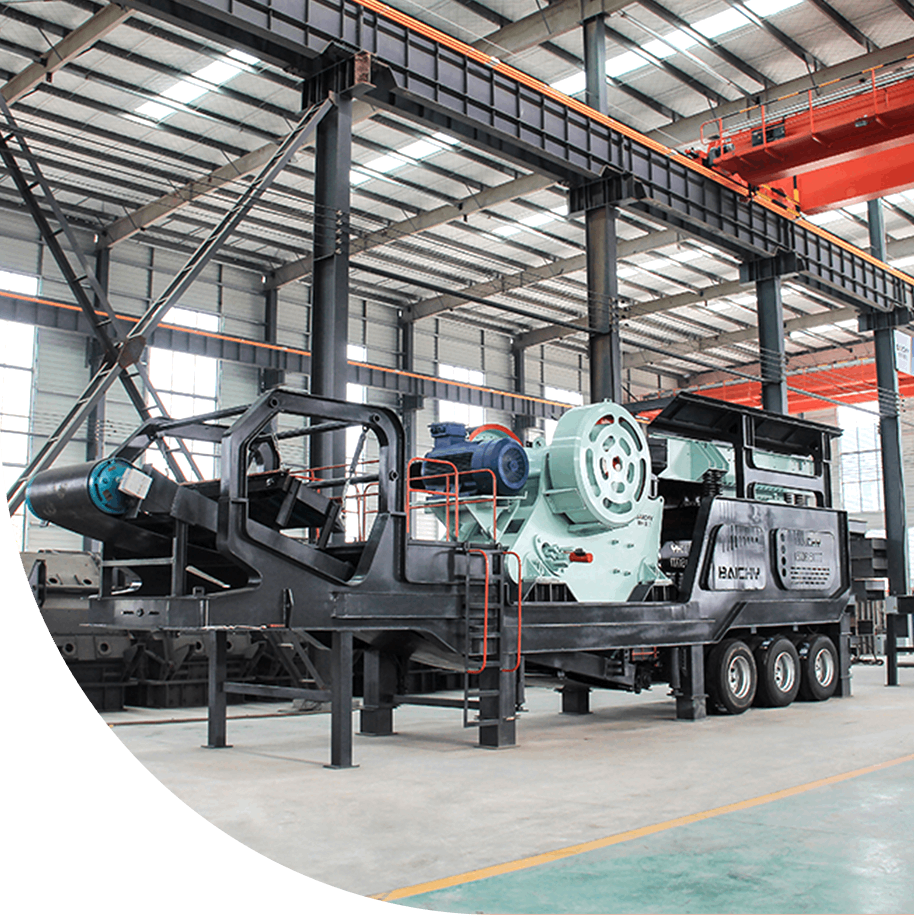
An impact crusher is a high-efficiency machine designed for crushing a wide range of materials, including hard rocks, minerals, and recycling materials. It operates by utilizing a high-speed impact force to break down materials. Unlike jaw crushers, which rely on compressive force, impact crushers use the force of impact to break materials into smaller pieces. This makes them particularly effective for secondary and tertiary crushing processes, where finer and more uniform output sizes are required.
I. How Impact Crushers Work
The working principle of an impact crusher is relatively simple. The material is fed into the machine, where it is struck by a high-speed rotor. The rotor throws the material against a series of impact plates or bars, which fracture the material into smaller pieces. The size of the output material can be adjusted by changing the speed of the rotor or the spacing between the plates. Impact crushers are often used for secondary or tertiary crushing, where the goal is to achieve fine material sizes.

II. Why Choose an Impact Crusher?
Impact crushers are ideal for processing materials that are tough and abrasive. Their ability to produce fine, consistent material sizes makes them essential for industries that require high-quality aggregates, such as construction, road building, and concrete production. The high-speed rotor and impact plates allow the crusher to handle larger quantities of material, ensuring high throughput and efficiency. Additionally, impact crushers offer lower operating costs compared to other types of crushers, making them a cost-effective choice for many operations.
III. Applications of Impact Crushers
Impact crushers are highly versatile and are used in several industries for various applications. In mining, they process ores and minerals, reducing them to smaller sizes for further treatment. In construction, they produce aggregates such as sand, gravel, and crushed stone for use in concrete, asphalt, and road-building projects. Impact crushers are also crucial in recycling, where they process concrete, asphalt, and demolition debris into reusable materials, making them ideal for sustainable construction practices. Additionally, they play a key role in aggregate production lines, ensuring that the output meets the required specifications.

IV. Advantages of Using an Impact Crusher
Impact crushers offer significant advantages, including high processing efficiency and the ability to handle a variety of materials. They produce a more uniform particle size, which is essential for industries like concrete production. Additionally, they are cost-effective, requiring less maintenance due to fewer moving parts compared to other crushers. Their versatility makes them suitable for a wide range of materials, from rocks and ores to recycling waste. Moreover, impact crushers tend to be more energy-efficient, providing a reliable and sustainable crushing solution.
Proper maintenance is vital for the long-term performance of impact crushers. Key maintenance tasks include inspecting and replacing the rotor and blow bars, which are subjected to significant wear and tear. Lubricating moving parts such as bearings and rotors helps reduce friction and prevent damage. Regularly checking impact plates for wear ensures effective material processing, and adjusting the output size based on operational needs helps maintain consistency in the final product. Cleaning the machine is also crucial to prevent material buildup that could reduce efficiency.
Q: How does an impact crusher work?
A:Impact crushers operate by using a high-speed rotor to strike and break the material against impact plates, reducing the material into smaller pieces. The output size can be adjusted by modifying the rotor speed or the spacing between the plates.
Q: What are the advantages of using an impact crusher?
A: Impact crushers offer high efficiency, uniform particle size, low operating costs, and versatility. They are ideal for processing a wide range of materials and provide consistent, fine material sizes.
Q: In which industries are impact crushers used?
A: Impact crushers are used in industries like mining, construction, recycling, and aggregate production to process materials such as ores, rocks, concrete, and demolition waste.