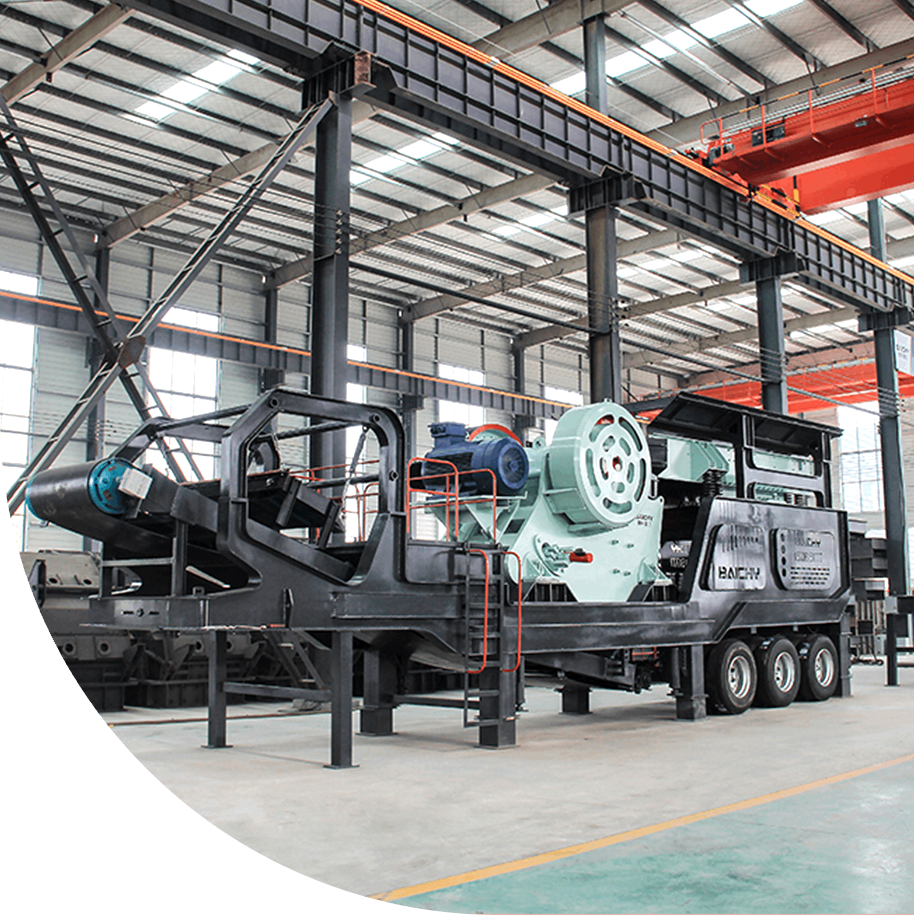
High-Efficiency Fine Crusher: When the Name Holds True
"High efficiency" is not a property a machine carries with it. On a fine crusher it describes one specific outcome: the share of material that leaves the rotor already inside the product band, in a single pass. Everything else — motor size, rotor speed, the number on the brochure — is an input to that figure, not a substitute for it.
This article explains where that efficiency actually comes from, the three conditions it needs, and what happens to the economics when one of them is missing.
I. What the Word Should Mean
A fine crusher is bought to replace a stage, not to add one. Its value is that material passes through once and comes out at a size that a screen can accept as product — replacing what would otherwise be a medium crusher plus a fine crusher, and the belt and transfer point between them.
• First-pass yield — the proportion of throughput that lands in the product band without being returned. This is the number that decides whether one machine replaced two.
• Circulating load — everything the screen sends back. A high figure means the machine is not "high efficiency"; it is being used as a pump.
• Cost per tonne in the product band — power plus hammers plus liners, divided by saleable tonnes rather than by tonnes through the rotor.
• Stability of the curve — whether the product still meets specification at the end of a hammer set's life, not just when it is new.

II. How the Machine Makes Its Product
A fine crusher is an impact machine pushed to a higher rotor speed and a smaller chamber than a conventional impact crusher. Material is struck by hammers, thrown against the impact plates, and then collides with other material in the chamber. Most designs run without a grate, so the discharge is open and the size is controlled by speed, clearance and the number of impacts a particle receives.
• Breakage is by impact, so brittle material responds and tough material does not. Limestone, shale, gypsum, coal spoil and demolition rubble break readily; hard, abrasive or plastic material absorbs the energy instead.
• The product curve is steep. Fine crushing produces a lot of material at the fine end and a small oversize tail — good for a specification with a top size, less good if you need a narrow mid-band grade.
• No grate means moisture tolerance. Damp feed passes instead of packing, which is why this machine suits quarries with wet seasons better than a grate-equipped hammer mill.
• Shape is better than a jaw or a cone at the same size. Impact breakage produces fewer elongated particles, which matters for concrete aggregate and for anything sold on shape.
III. Three Conditions That Have to Hold
The machine is genuinely efficient, and the single-stage argument genuinely holds, only when all three of these are true at once.
1.Material that breaks rather than grinds
Fine crushing concentrates energy into a small chamber, so abrasive rock turns that energy into hammer wear instead of new surface. Ask what the silica content does to a set of hammers before accepting a cost per tonne.
2.A product band the machine can actually reach
A fine crusher can make a coarse sand or a small aggregate. It cannot make a tightly specified fine powder, and pushing it there means higher speed, more wear and a steeper curve than the specification allows.
3.A screen that closes the circuit
Open discharge means open grading. Without a screen returning oversize, the machine delivers whatever the chamber makes that day and the top size drifts with hammer wear. The screen is what converts impact breakage into a specification.
Remove any one and the economics change. Abrasive rock moves the cost into hammers; a finer target moves it into power and circulating load; no screen moves it into rejections. None of those outcomes is visible in a capacity figure.

IV. Where It Ends and the Next Machine Begins
| Machine | Product it is built for | Strength | Where it stops |
| Fine crusher | Coarse sand to small aggregate | One pass replaces two stages; good shape; moisture tolerant | Hammer cost on abrasive rock; cannot reach fine powder |
| Impact crusher | Medium aggregate | High reduction in one pass; cubical product | Lower speed, coarser product; same wear question |
| Vertical shaft impactor | Sand and shape-critical aggregate | Best shape; rock-on-rock option for wear | Higher power per tonne; lower output for the same drive |
| Short-head cone | Fine aggregate from hard, abrasive rock | Wear cost stays predictable; stable setting | No shape improvement; cannot match impact on cubicity |
The boundary is the product, not the tonnage. Two plants at the same output can need different machines because they sell different curves — and the fine crusher is the one whose economics swing most sharply with that difference.
V. The Hammer Is the Setting
On a jaw or a cone, the setting is a number you adjust. On a fine crusher, the working clearance between hammer and impact plate is the setting — and it grows as the hammer wears. That has two consequences worth planning for.
• The product drifts coarser as the hammer set ages. A screen in closed circuit hides this until the circulating load becomes unmanageable, at which point the plant's output has already fallen.
• Hammer changes are a production event. Rotor access, lifting arrangement and the number of hammers per row decide whether a change takes an hour or a shift — and on a single-stage plant, that shift is the whole line.
• Buy hammers on tonnes, not on price. A set that lasts longer at a higher price is usually the cheaper set; what matters is the cost per tonne of product, measured on your rock.
• Keep the rotor balanced. Replacing hammers on worn pins reproduces the imbalance that caused the uneven wear, and imbalance is what turns a wear item into a bearing failure.
VI. Three Mistakes at Commissioning
• Running it open circuit. Without a screen, the top size is whatever the chamber produces, and every hammer change silently changes the product.
• Feeding it material it was not sized for. A fine crusher wants a controlled, graded feed. Run-of-mine lumps produce power spikes, uneven wear and a curve nobody can predict.
• Ignoring moisture and clay. The open discharge tolerates damp feed, but sticky feed still coats the chamber and blinds the screen downstream — the machine is not the bottleneck, the screen is.
• Treating it as the whole plant. It replaces a stage, not the circuit. It still needs a feeder that delivers a steady curtain, metal protection ahead of it, and a screen behind it.
VII. What to Ask the Supplier For
• First-pass yield at a stated feed gradation — not a capacity figure on its own, but the share of output inside the band.
• Hammer life in tonnes on material similar to yours, and the hammer weight and metallurgy.
• The screen arrangement assumed by the quotation, including aperture and return rate.
• Maximum feed size and the moisture the chamber tolerates, plus what happens above it.
• Access for a hammer change: how the rotor is exposed, and how many people it takes.
• Installed power per tonne of in-band product, so the single-stage argument can be checked against a two-stage quotation.
Frequently Asked Questions About Fine Crushers
Q: Can a fine crusher replace both a secondary and a tertiary stage?
A: It can, and that is its main economic case — provided the product band is within reach and a screen closes the circuit. On a finer specification the same machine becomes a circulating-load problem rather than a replacement.
Q: How is it different from an impact crusher?
A: Same breakage mechanism, smaller chamber and higher rotor speed. The impact crusher is built to make medium aggregate; the fine crusher is built to make the size below it in one pass, at the cost of hammer life.
Q: Will it work on hard, abrasive rock?
A: It will run, but the hammer bill becomes the deciding number. Compare cost per tonne of product against a short-head cone before committing, and ask for hammer life on your material rather than on limestone.
Q: Does it need a screen?
A: For any specification with a top size, yes. Open discharge gives a broad curve that moves as hammers wear; the screen is what makes the product repeatable.
Q: Why does output fall over a hammer set's life?
A: Because the clearance grows and the product coarsens, so more material returns. Output has not changed at the rotor; the yield inside the band has. That is why hammer life is a capacity figure, not a maintenance figure.
For fine crushing machines matched to a closed circuit, see the fine crusher range.