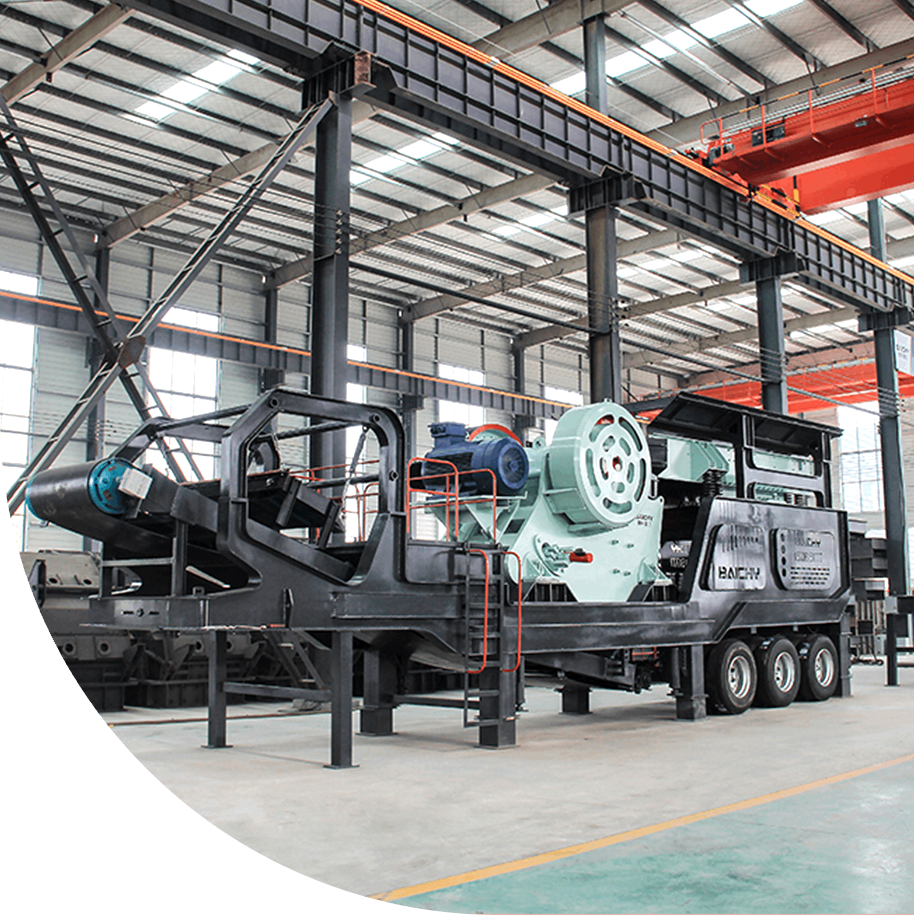
30-60 t/h Fixed Crushing Line: Fewer Stages, Better Margin
At 30-60 tonnes an hour, almost nobody loses money because the line is too small. They lose it because the line was designed like a bigger one. At this scale, every extra stage, belt and control cabinet takes a disproportionate share of the tonne — and the plant is then run permanently below its design point, which is where product shape and wear rates quietly go wrong.
This article sets out how to decide the number of stages, how to pick equipment inside a 30-60 t/h band, and what the layout has to deliver when one person is watching the whole plant.
I. What This Output Level Actually Implies
Thirty to sixty tonnes an hour is one loader feeding the hopper, trucks arriving one or two at a time, and a stockyard that holds a few days of production. That operating pattern sets the design more than the tonnage does.
• The largest lump in the feed decides the primary's feed opening, and it is usually the number buyers under-report.
• How many product sizes you must sell decides the screens — and this, not tonnage, is what pushes a small plant into three stages.
• The height difference on site decides how much of the plant runs on gravity instead of belts.
• Fixed costs do not scale down. A control cabinet, a platform, a spare-parts set and a maintenance contract cost roughly the same here as on a plant three times the size.
That last point is the whole argument. At 30-60 t/h, capital per annual tonne is dominated by things that do not shrink with throughput — so adding equipment to "be safe" is the most expensive decision available.

II. Rule One: The Fewest Stages That Meet the Specification
| Configuration | Product sizes | Where it hurts | Choose when |
| Single stage, heavy hammer | One band, wide tolerance | Coarse, broad curve; hammer wear on abrasive rock | Soft to medium feed, one product, low capital |
| Two stages, closed circuit | Two or three sizes | Needs a return belt and a screen that earns its place | The default for most 30-60 t/h duties |
| Three stages | Three or more, shape critical | Two extra belts, two transfer points, more power | Shape specification, abrasive feed, or staged expansion |
Count what a stage actually costs. One crusher, one drive, one belt in and one belt out, a chute, a transfer point, a starter in the panel, two lines of interlock logic, and a place where material can block at two in the morning. On a 200 t/h plant that list is diluted. Here it is not.
The usual reason a small line ends up with three stages is a specification written for a bigger market: three sizes plus a shape requirement. That is a legitimate reason. "In case we need it later" is not — later can be served by foundations and a panel with spare ways, which cost a fraction of a crusher.
III. Rule Two: Size for the Duty, Not the Ceiling
A 30-60 t/h band means the plant will spend most of its life somewhere in the middle. Design at the middle, and let the screen and the crusher setting absorb the peaks.
• A jaw run half empty produces slabs. The chamber needs to be full to break by compression rather than by chance; a starved jaw gives a flakier product and wears its plates unevenly.
• An impact crusher at low load loses shape. Much of its cubical product comes from stones hitting each other in a full chamber. Throttle the feed and the curve coarsens.
• A screen with a thin bed loses efficiency. Bed depth is part of how a screen stratifies; running far below design makes the deck less effective, not more gentle.
• Oversizing moves the cost, it does not remove it. Larger motors draw more at part load, larger belts need larger structures, and the capital sits in the ground earning nothing.
• Peaks belong in the stockpile. If a customer occasionally wants a full truck at short notice, hold a day of stock — cheaper than a plant that can make it in an hour.

IV. Rule Three: One Person Has to Be Able to See the Whole Line
At this output the labour line is short — often one operator and one loader driver. That makes the layout an operating decision, not an aesthetic one.
• Keep the control point single. One panel, one place to stand, with the crusher discharge and the screen in sight. Split panels mean split attention.
• Let gravity do the lifting. Use the site's fall. Every belt removed is a drive, a set of idlers and a fault code that no longer exists.
• Count the transfer points. Each one is dust, wear liner, spillage and a blockage risk — and on a small plant they dominate the maintenance hours.
• Build access into the structure. A platform at the jaw, one at the screen, and a walkway that does not require stopping the plant. Liner and panel changes are the routine work here.
• Group the drives. Starters and drives in one place make fault-finding a ten-minute job instead of a walk around the site.
V. Where the Number Inside the Band Comes From
Thirty to sixty is a range, and someone has to choose a design point inside it. That choice should follow the market, not the equipment list.
• Design at the middle of the band, then confirm the crushing chamber can be adjusted to either end without changing hardware.
• Check the feed before the machines. If the deposit can only deliver forty tonnes an hour of the right size, no plant will make sixty.
• Check the selling side. A line that can make three sizes but only sells one is paying for screens it never uses.
• Check the shift pattern. Two shifts at the lower figure often beats one shift at the higher one, because the second shift uses the same capital.
VI. When Three Stages Is the Right Answer
There are real cases, and they are worth naming so the decision is made deliberately rather than by habit: a specification with three or more sizes where each must be within a band; a shape requirement that only a vertical shaft impactor can meet after a cone; an abrasive feed that rules out a single-stage hammer; or a site where the deposit is mixed and the plant has to separate rather than reduce.
In each case the third stage is bought for a reason that shows up on an invoice or a rejection note. If the reason is "flexibility", the cheaper version of flexibility is a foundation, a spare way in the panel and a layout that leaves room.
VII. What to Ask the Supplier For
• A mass balance at the design point, in finished tonnes, including the return stream.
• Feed gradation and largest lump assumed, and what the output becomes if the real feed is finer, wetter or blockier.
• Installed power per tonne of product, so two quotations can be compared on running cost rather than on price.
• The number of transfer points and belts, stated as a count — it is the best single proxy for maintenance hours.
• Access: platforms, walkways, and whether a liner can be changed without a crane.
• A wear-parts list with expected life in tonnes, not in months.
Frequently Asked Questions About 30-60 t/h Lines
Q: How many crushing stages does a 30-60 t/h line need?
A: Two, in most cases: a primary and a secondary in closed circuit with a screen. One stage works for soft to medium feed with a single product band; three stages only when the specification genuinely demands it.
Q: Can I size the plant for 60 t/h and normally run at 30?
A: You can, but the machine will spend its life starved. Product shape suffers, plates wear unevenly, and the screen loses efficiency. Better to design near the middle and hold stock for peak demand.
Q: Fixed line or mobile plant at this output?
A: The tonnage does not decide it; the site does. A fixed line suits a deposit with years of life, reliable power and usable ground slope. A mobile or modular unit suits short workings and sites that move.
Q: Which second stage — impact or cone?
A: Impact for limestone and similar rock where shape matters and abrasion is moderate. Cone for hard, abrasive feed where the wear bill on blow bars would dominate the cost per tonne.
Q: How should the plant be prepared for future expansion?
A: In the ground and in the panel, not in the equipment list. Foundations, structural capacity and spare ways in the control cabinet are cheap at build stage and expensive later.
For equipment matched to this output band, see the fixed crushing plant range.